
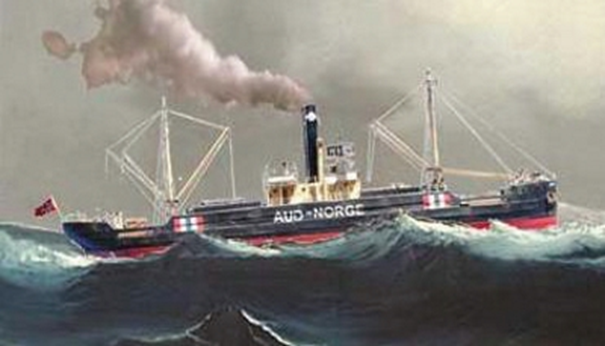
When we think of the 1916 Easter Rising, we see it as a Dublin phenomenon: we speak of the heroism at the GPO, the sharp crack of rifles in St. Stephen’s Green, and the ultimate sacrifice of the signatories. But there is a chapter of the 1916 Rising that played out far beyond the cobblestones of Dublin on the violent swells of the North Atlantic; a little-known story that directly shaped the course of the Rising. This is the story of the SS Aud.
Ironically, for a ship planned to play a key role in the Irish fight for freedom, the ship we remember as the Aud was born as the SS Castro, a British merchant vessel built in Hull in 1907. At the outbreak of World War I in 1914, she was captured by the Imperial German Navy in the Kiel Canal and renamed SMS Libau.
When Roger Casement and the IRB Military Council finally succeeded in securing German military aid, the plan was for the Libau, refitted and disguised as a neutral Norwegian freighter, SS Aud, to slip through the British blockade that was currently strangling German ocean access.
Under the command of 28-year-old Captain Karl Spindler and crewed by 22 German naval volunteers dressed as Norwegian civilians, she departed Lübeck on April 9, 1916, on one of the most daring covert operations of the war. Below her decks lay the material for a nationwide insurrection: 20,000 rifles, 1 million rounds of ammunition, 10 machine guns, and explosives.
An oft-quoted myth is that the weapons supplied by the Germans were obsolete, perhaps sparked by Casement’s belief that Germany was supporting Ireland on the cheapest possible terms. They were not standard German weapons, but captured Russian Mosin-Nagant Model 1891 rifles, taken after the German victory over the Russians at the Battle of Tannenberg. While they were indeed useless to the Germans (they were of a different caliber than German-supplied ammunition), they were modern rifles known for being easy to use by inexperienced troops and highly effective. They would have dramatically changed the scale of the Rising beyond Dublin.
Captain Spindler’s route was a masterclass in evasion. To avoid the British 10th Cruiser Squadron, tasked with enforcing the blockade, he steered far north along the Norwegian coast, crossed the Arctic Circle, and then turned south toward Ireland.
The voyage was punishing. Off Rockall, the ship was battered by violent storms, with waves threatening to tear her apart. Yet despite weather and patrols, the Aud reached the southwest coast of Ireland undetected on Holy Thursday, April 20, 1916.
However, from the outset, the mission depended on precision. In its guise as a civilian Norwegian freighter, the Aud carried no radio, relying entirely on prearranged signals, timing, and coordination with the Volunteers ashore.
The original plan called for a landing between April 20 and April 23 at a rendezvous point off Inishtooskert Island in Tralee Bay. A pilot boat displaying two green lights would guide the ship in.
But the plan unraveled. Fearing premature discovery, the Military Council attempted to delay the landing through messages routed via the United States. Those changes never reached Spindler.
The Aud arrived exactly on schedule—and found nothing.
As the Aud waited offshore, events on land collapsed into tragedy. Volunteers dispatched to secure wireless equipment necessary for signaling the ship met disaster at Ballykissane Pier, when their car plunged into the River Laune, drowning Donal Sheehan, Con Keating, and Charlie Monaghan; the first fatalities of the 1916 Rising. The loss was not only tragic but also ensured there would be no contact with the Aud and extinguished any chance of salvaging a mission that already depended on fragile, prearranged coordination.
After nearly a day without contact, Spindler knew the mission had failed. On April 21, the ship was intercepted by HMS Bluebell. Despite his best attempts at bluff, the British commander saw through the deception; British intelligence had already been alerted by intercepted communications and had communicated a warning to patrol boats.
Escorted toward Queenstown (Cobh), Spindler made his final decision. Near Daunt Rock at the entrance to Cork Harbor on April 22, the crew donned their previously hidden German naval uniforms, raised the German Imperial flag, and scuttled the ship.
Explosive charges were detonated. Within minutes, the Aud slipped beneath the waves, taking with her the arms that might have changed the Rising.
The Rising had been hopelessly compromised; with Casement, who had been separately arrested on his return to Ireland, and the Aud captured, there was no option but to proceed. MacNeill’s countermanding order was unrealistic and only deepened confusion at the moment clarity was most needed.
When the Rising began on Easter Monday, it did so largely confined to Dublin, lacking the arms and coordination its planners had envisioned for a broader rising. It turned its objectives from military to political.
Today, the Aud rests at roughly 30 meters (100 feet) of depth outside Cork Harbor. In 2012, her anchors were recovered; one now stands in Cobh, the other in Fenit.
The Aud was not a failure of courage, but of coordination. She navigated the storms of the North Atlantic and the British blockade, only to founder in the fog of war.