
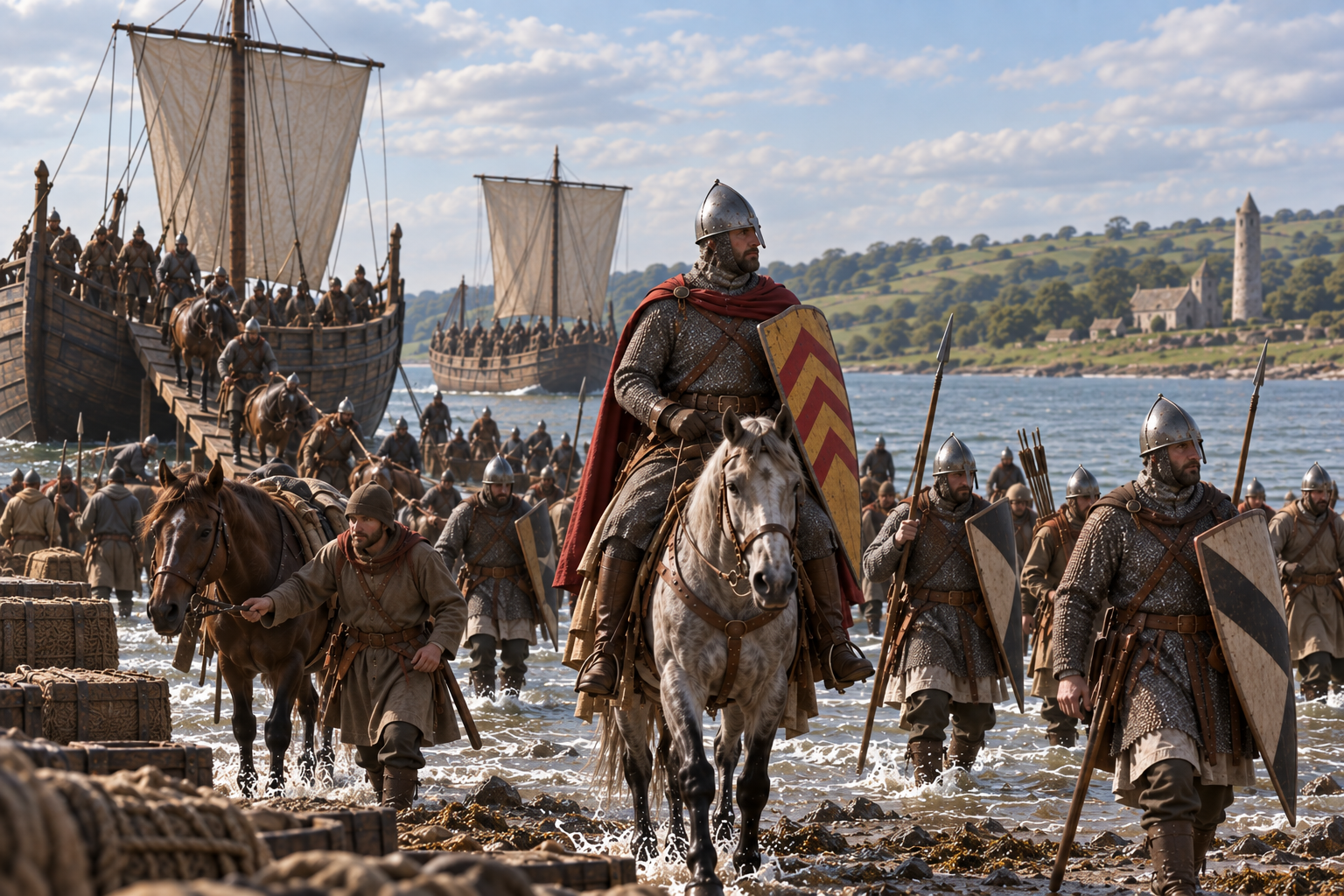
On 1 May 1169, three foreign ships cut through the gray surf off the coast of County Wexford and beached their keels on the gravel spit of Bannow Island. Out from the hulls stepped roughly thirty Norman knights encased in chainmail, accompanied by sixty mounted men-at-arms and three hundred archers and foot soldiers from the Welsh marches, led by Robert FitzStephen.
For generations, the conquest that followed was justified by portraying medieval Ireland as a backward land in need of outside order. Yet that version of history is a self-serving English myth. Gaelic Ireland possessed its own sophisticated legal tradition in the Brehon laws, renowned centers of learning, a deeply rooted Christian tradition, and its own political and cultural institutions.
What landed at Bannow was not the forces of order. It was a force of military adventurers.
The man who summoned these foreign warriors was Diarmait Mac Murchada, the deposed king of Leinster. Driven into exile in 1166 after being defeated by his Irish rivals, Mac Murchada sought foreign military power to regain his kingdom.
He eventually reached an agreement with Richard de Clare, the Earl of Pembroke known to history as Strongbow. In exchange for military assistance, Strongbow secured a promise of marriage to Diarmait’s daughter Aoife and succession to Leinster.
But what Mac Murchada unleashed would soon grow far beyond the restoration of one deposed Irish king. Strongbow’s followers were not simply warriors seeking payment and passage home. They were feudal freebooters seeking land and lordships of their own.
By late August 1170, Strongbow landed at Passage East, Waterford with two hundred heavily armored knights and approximately one-thousand-foot soldiers. His vanguard, led by Raymond le Gros, had already entrenched itself at Baginbun. When several hundred Irish defenders from Waterford attempted to dislodge them, the invaders drove a captured herd of cattle into their ranks, scattering the defenders.
The aftermath revealed the calculated brutality of the newcomers. Gerald of Wales, himself an enthusiastic chronicler and defender of the Anglo-Norman conquest, records that seventy captured town leaders and warriors had their limbs deliberately broken before they were beheaded and hurled from the sea cliffs into the waves below.
Waterford soon fell in a ferocious assault that reportedly left 700 defenders dead. Strongbow then celebrated his wedding to Aoife in the captured Irish port. Not long afterward, the invading force marched north toward Dublin. High King Ruaidrí Ua Conchobair marshaled an army to block the customary approaches, but the invaders bypassed the Gaelic force through the Wicklow Mountains, stormed Dublin, and established an armed garrison there.
The English Crown watched this private baronial expansion with growing suspicion. Henry II had no intention of allowing Strongbow to establish an independent power across the Irish Sea. In October 1171, Henry landed at Waterford with a formidable royal expedition of some four hundred ships and approximately four thousand troops. His arrival brought the expanding conquest under the authority of the English Crown.
The political settlement was more complicated than outright conquest of the entire island. Gaelic kings continued to rule substantial territories, and the Treaty of Windsor in 1175 recognized Ruaidrí as king over much of Ireland, though subordinate to Henry. The English Crown had asserted a claim to sovereignty in Ireland.
Religion was invoked to justify that claim.
The Crown pointed to the papal bull Laudabiliter, allegedly issued by Pope Adrian IV, the only English Pope elected, around 1155. Its authenticity, wording, and later use have long been disputed. Gerald of Wales would make it part of his justification for English intervention, portraying Henry’s involvement as necessary to reform abuses within the Irish Church.
Bannow marks the beginning of a relationship that would shape Irish history continuing to today. English control over Ireland would expand and contract over the centuries. But the claim first asserted in the twelfth century, that an English crown had the right to exercise sovereignty over Ireland, endured.
Ireland would become a testing ground for methods of conquest and control that Britain would later employ across a much larger empire: military occupation, land confiscation and plantation, displacement of native elites, suppression of language and culture, religious discrimination, and laws separating the colonizer from the colonized. Ireland was not simply another chapter in the history of British imperialism. In important ways, it was its laboratory.
This history deserves particular attention as Europe prepares to mark 2027 as the European Year of the Normans. There is much in Norman history worthy of study. But commemoration should not become hero worship, and history should not become hagiography.
Ireland provides a necessary corrective.
The Norman story looks very different from Bannow Bay than it does from Bayeux. Ireland was not an empty canvas awaiting civilization. It possessed its own laws, learning, Christianity, political institutions, language, and culture.
The ships that arrived at Bannow carried soldiers. They did not carry civilization.