
Whenever Ireland takes an independent stand on international affairs, particularly one that displeases powerful interests, a familiar accusation resurfaces. Ireland, we are told, was sympathetic to Nazi Germany during the Second World War. Its neutrality was supposedly evidence of moral cowardice, if not outright support for fascism.
More than eighty years after the war, this accusation remains a convenient weapon against Ireland.
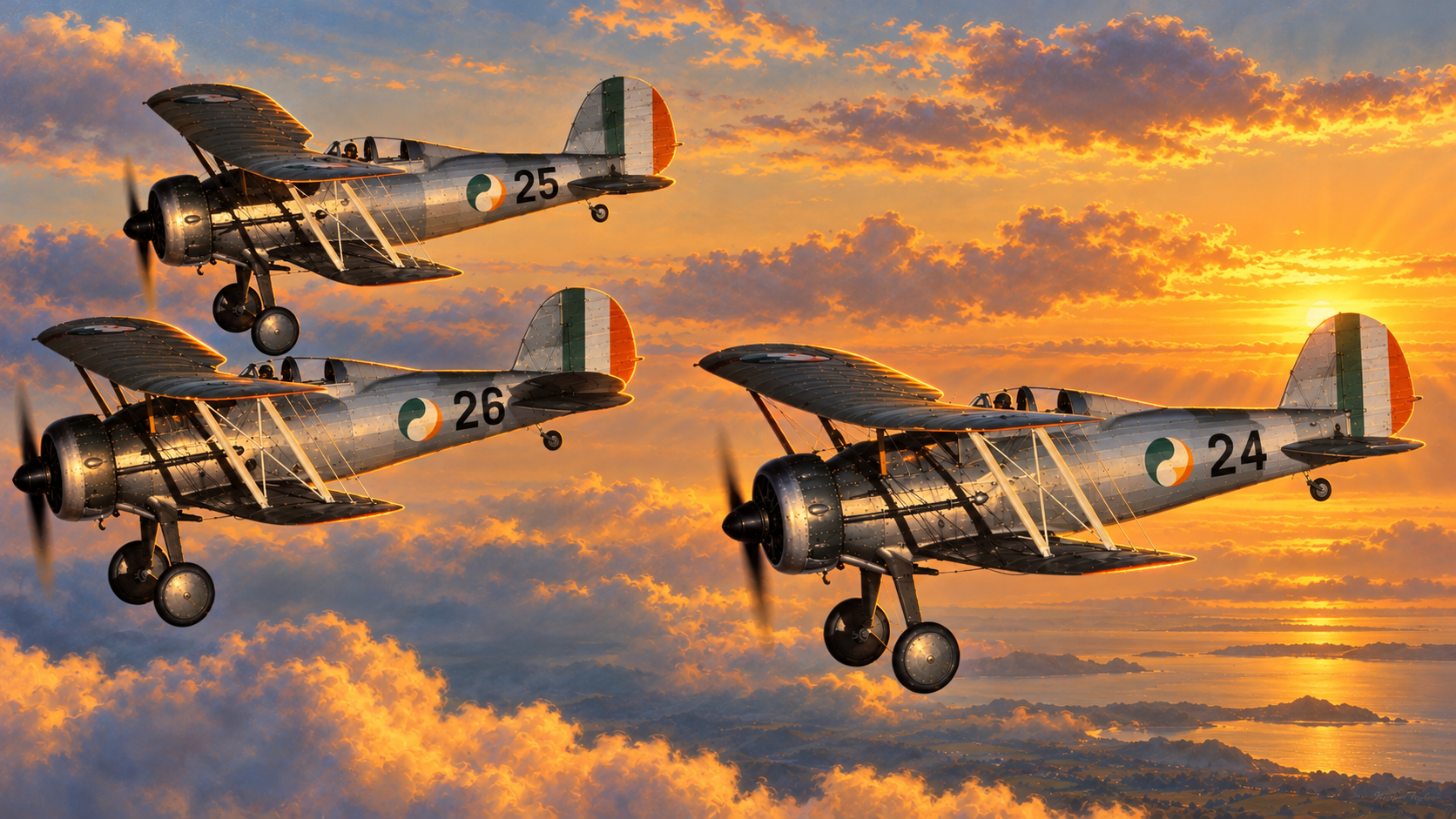
At the center of that accusation is one incident: Taoiseach Éamon de Valera’s visit to the German minister in Dublin in May 1945 to convey condolences following Adolf Hitler’s death.
It was a serious failure of political judgment, reflecting de Valera’s rigid adherence to diplomatic protocol, a compulsive need to show that Ireland act as a mature nation. Yet those who portray it as proof of Irish sympathy for Nazism overlook Ireland’s very different response to the death of President Franklin D. Roosevelt just weeks earlier.
De Valera paid tribute to Roosevelt in the Dáil, adjourned proceedings as a mark of respect, had official flags lowered, sent a sympathetic message to President Harry Truman, and attended a memorial Mass. American Minister David Gray did not open a formal condolence book, so there was no equivalent diplomatic visit. More on his motives later.
One response was a public national tribute to an Allied leader; the other, a tone deaf pro forma diplomatic gesture. Neither should be confused with Ireland’s actual wartime record.
Neutrality Born of Necessity
When Britain declared war on Germany in September 1939, Ireland was a young state, less than two decades removed from a devastating civil war and still confronting partition.
Ireland simply lacked the military resources to fight a modern war. Its small army had little heavy armor, its air corps possessed no modern fighter force, and its antiaircraft defenses were woefully inadequate. Entering the conflict would have exposed Irish cities to German bombing without the means to defend them effectively.
There was also the question of sovereignty. After centuries of British rule, Ireland was not about to surrender its independent foreign policy simply because London had entered another European war. Ireland’s only substantial military resource was its manpower, and committing Irish soldiers to a war under British command was hardly acceptable for a nation still establishing its independence.
Neutrality was both a practical necessity and an assertion of independence.
But neutrality did not mean indifference to the outcome. De Valera understood that a Nazi victory threatened Ireland’s own freedom. He assured British representative Sir John Maffey that Ireland would provide every conceivable assistance short of openly joining the conflict.
What emerged was public neutrality accompanied by extensive, often secret, cooperation with the Allies.
The Hidden Allied Partnership
In February 1945, Viscount Cranborne, Britain’s Secretary of State for Dominion Affairs, prepared a confidential memorandum identifying fourteen areas in which neutral Ireland had assisted the Allied war effort.
This was not an Irish nationalist defending de Valera. It was a senior British minister privately documenting assistance his country had received.
In 1941, Ireland permitted Allied aircraft based in Northern Ireland to cross Irish territory through the Donegal Corridor. This shortened their journey to the Atlantic, extending patrol time and improving their ability to protect convoys and hunt German submarines. On May 26, 1941, a Catalina flying boat that transited the corridor helped located the German battleship Bismarck leading to it destruction.
Irish assistance was not confined to the Donegal Corridor. British rescue vessels operated from Irish ports, while Ireland’s eighty-three coastal lookout posts monitored shipping and aircraft. Information about German submarine movements and other suspicious activity was shared with British authorities.
In June 1944, twenty-one-year-old Maureen Flavin, working at Blacksod Point in County Mayo, recorded a sharp fall in atmospheric pressure warning of an approaching Atlantic storm. Her observations helped Allied meteorologists recognize the approaching storm, prompting General Dwight D. Eisenhower to postpone the Normandy invasion from June 5 to June 6, when a brief improvement in conditions offered an opportunity to proceed.
The treatment of military personnel offered another revealing contrast. An April 1944 Irish government memorandum acknowledged that Allied airmen landing in Ireland were “presumed to be on non-operational flights unless proven otherwise”. German airmen, in contrast, were interned for the duration.
Ireland’s intelligence cooperation was equally significant. Irish Military Intelligence, G2, worked closely with Britain’s M15 to identify German agents, intercept communications, and disrupt espionage operations.
Dr. Richard Hayes, Director of the National Library of Ireland, played an important role in breaking German intelligence codes. His work and that of G2 helped British intelligence exploit communications that German agents believed secure.
Following the war, senior M15 official Cecil Liddell praised the vigor and integrity of Irish counter-espionage efforts.
Such cooperation was hardly the conduct of a nation sympathetic to Nazi Germany.
A Tale of Three Neutral Countries
Critics of Ireland’s neutrality seldom apply the same critical standards to Sweden and Switzerland, both of which possessed substantially stronger military forces.
Sweden supplied Nazi Germany with iron ore, specialty steel, and precision ball bearings essential to its aircraft, tanks, and weapons production.
Switzerland helped Nazi Germany convert vast quantities of gold, including gold looted from occupied Europe and victims of Nazi persecution, into the foreign currency needed to purchase war materials.
Contrast that with Ireland, which provided the Allies with intelligence, airspace, weather observations, and operational assistance while releasing Allied airmen and interning German crews.
Sweden and Switzerland have faced historical scrutiny, but their wartime conduct is not routinely resurrected to discredit them.
Why, then, does Ireland’s neutrality remain a recurring accusation of Nazi sympathy?
The Making of a Political Myth
Two figures helped shape the hostile narrative: American Minister David Gray and British Prime Minister Winston Churchill.
Gray, a political appointee related to Eleanor Roosevelt, was deeply antagonistic toward de Valera and concerned that Irish American influence might pressure Washington to challenge partition after the war.
In 1943, Gray proposed demanding access to Irish ports and airfields. Though strategically located, the ports lacked the infrastructure to serve as major naval bases, and American military planners questioned whether they would be needed.
But Gray had another motive: an Irish refusal could be used to portray Dublin as unwilling to assist the United States and undermine Irish American efforts to challenge partition after the war.
In February 1944, Gray demanded the expulsion of Axis diplomats, claiming their presence endangered Allied security. De Valera refused.
Yet British intelligence opposed the expulsion. Ireland had already confiscated the German legation’s radio, forcing communications onto channels M15 could intercept. Working with Irish intelligence, MI5 was monitoring the diplomats and feeding misinformation to Berlin. Expulsion would jeopardize this valuable operation.
Gray knew this. Remarkably, he even proposed wording for the American Note intended to prevent de Valera from citing the confiscated transmitter in Ireland’s defense.
Was Gray protecting Allied security, or manufacturing a politically useful Irish refusal?
Churchill reinforced the narrative in his May 1945 victory broadcast, condemning Irish neutrality while praising Northern Ireland’s loyalty. Yet his government possessed the Cranborne memorandum documenting Ireland’s extensive assistance to the Allies.
The result was a damaging public narrative that concealed Irish cooperation while undermining de Valera’s standing and Irish American efforts to challenge partition.
A Smear That Will Not Die
The consequences of this smear campaign did not end in 1945.
More than eighty years later, accusations of Irish sympathy for Nazism continue to resurface when Ireland’s foreign policy displeases its critics. Contemporary disputes deserve to be judged on their merits. Reviving an eighty-year-old specious accusation of Nazi sympathy does nothing to resolve them. Ireland opened its airspace to Allied patrols, supplied naval and coastal intelligence, assisted Allied airmen, shared German espionage information, and provided weather observations vital to military operations.
A nation that quietly assisted in the defeat of Nazi Germany should not be condemned as a friend of fascism, but applauded for doing the most it could do with what it had.
It is time the historical record received as much attention as the accusation.